Thursday, March 19, 2020

DE: Time To Try Out Some Wyches

This is the type of girl you bring home to mom.

For tonight's game, I'm going to introduce a unit of Wyches to support my Kabal.  I've bounced and forth on which Cult I would like to get into my game, and I think I settled upon the Cult of Strife.  Yes, this was a big change to what I was thinking before (Red Grief) but this is primarily because I want to justify taking a CC unit in a predominately shooty army.

My general philosophy with army building is this:  The more you detract from the focus of your army (in my case, it's shooting), the less effective your army will be overall.  I will be covering this topic more in-depth in Friday's post, but for now, let's talk about why I'm going to take the Cult of Strife.

First, the list:
1998 // 7 CP

Black Heart Battalion +3 CP

HQ:
Archon, Djin Blade, Blaster, PGL = 96
Warlord Trait: Labyrinthine Cunning

Archon, Huskblade, Blaster, PGL = 96
Raider, Dark Lance = 85

TROOP:
10x Warriors, 2x Blaster, Dark Lance = 114
Raider, Dark Lance = 85
199

10x Warriors, 2x Blaster, Dark Lance = 114
Raider, Dark Lance = 85
199

10x Warriors, 2x Blaster, Dark Lance = 114
Raider, Dark Lance = 85
199

10x Warriors, 2x Blaster, Dark Lance = 114
Raider, Dark Lance = 85
199

HEAVY:
Ravager, 3x Dinsintegrators = 125

+++

Black Heart Air Wing +1 CP

FLYER:
Razorwing, 2x Dinsintegrators = 135
Razorwing, 2x Dinsintegrators = 135

+++

Strife Patrol +0 CP

HQ:
Succubus, Adrenalight, Whip = 54
Warlord Trait: Blood Dancer

TROOP:
9x Wyches, Grave Lotus, Agonizer/BP, Shardnet = 91

The rest of the army should be pretty explanatory since it's pretty much the same old same old.  Where this is really different is that I'm spending 243 points for a CC component in the army that is delivered using a Raider.  For the delivery of Wyches, I want to try both:  Footslogging an epic ton of 20 girls up the table and see what happens to them, or just have them ride in a Raider that can hopefully protect them from harmful fire.  For tonight's game, I want to try the Raider because that's what I know.  Don't worry though, I absolutely plan on trying a 20-girl footslog and just run them up the board like cats on fire (or laced with drugs).

Cunning and Blood Dancer.  Why not, let's try it.

I'm also going to commit 2 CPs to take an extra Warlord trait for Blood Dancer and take an extra Artifact.  The reason why I'm doing this is to keep Cunning in play so I can hopefully get a refund for this upfront expenditure on precious resources.  I'm also crazy about Blood Dancer on Strife because that Warlord trait is INSANE with the Triptch Whip.  The whip is basically a +3 attack Agonizer that when you factor in Strife's +1 attack bonus and Adrenalight's +1, you have a 9 attack Succubus that hits on 2s, re-roll 1s, and Blood Dancer (Cult specific Warlord trait) allows you to count each 6 to Hit as 3 hits instead of 1.  I'll let you do the math for this because this makes her one of the most destructive single-wound infantry blenders in the game.  Is it worth the 2 CP?  Probably not.  Does she still die like a bitch if she fails her 4++ and subsequent 6+++?  Of course.  However, I'm feeling extra greedy tonight and I also want to keep Writ of the Living Muse for extra lels.  Otherwise, I might try keeping 6 KP so I have 2 for sure uses of Agents of Vect and just keep the Warlord trait and not the artifact (Living Muse).

Oh, and Shardnets.  Shardnets got a huge improvement because as long as you have this in the unit, your opponent only rolls D3 to get away while you roll D6.  Get dunked on son.  The more I type, the more inclined I am to take a giant unit of Wyches and just say F it.  For now, I'm going to buy a Black Heart Raider for my Archons that I'll end up lending to the ladies to use since transports (like Raiders and Venoms) are not cult specific.  That means anyone can use them and they still retain their bonus (like the 6+++).  This also means you might be able to pull off some potentially crazy combinations in the future (like Flayed Skull lending a +3" movement Raider for the Wyches!) but that's another story for another time.

Let me know what you think:  Should I go big and walk the Wyches?  Are Raiders still the best delivery mechanism?  Yes, I'm very aware of WWPs as an option as well.

Monday, March 16, 2020

Physics Book Face Off: The Hidden Reality Vs. Parallel Worlds

It has been an awfully long time since my last Physics Book Face Off, and that's mostly because it seems that I read pop physics books very slowly. I haven't even gotten into the real physics books that I eventually plan to read on relativity, string theory, and the like, but that's okay because I'm still enjoying these gentle forays into the technical details of the universe. For this pair of physics books, I dug into the idea of multiple universes with The Hidden Reality: Parallel Universes and the Deep Laws of the Cosmos by Brian Greene and Parallel Worlds: A Journey Through Creation, Higher Dimensions, and the Future of the Cosmos by Michio Kaku. Physicists have a bunch of different ideas about the possibility of other universes lying outside our own, and both of these books, by authors I've read before, set out to explore those wide-ranging ideas.

The Hidden Reality front coverVS.Parallel Worlds front cover

The Hidden Reality

Having thoroughly enjoyed The Elegant Universe, I had high hopes for this book, and Brian Greene did not disappoint. His clear and thoughtful explanations of complex topics in physics again made for an enjoyable and thought-provoking read. However, it is important to be careful and pay attention when he's discussing string theory, because he's prone to exaggerating the conclusions that can be drawn from the theory as it stands, lacking in essential evidence.

Let's not let that small failing get in the way of learning about the possibilities that Greene covers in this book, where he goes through nine different possibilities for multiple universes, otherwise known as the multiverse. He starts out simply by describing how we know that the universe we live in is far larger than what we can see, even through our most powerful telescopes. Because there is more universe that lies beyond what we can observe, we can consider that part of the universe separate from ours, giving us a patchwork quilt of universes, each containing its own galaxies, stars, and solar systems.

Assuming the universe is infinite leads to the conclusion that all possible configurations of solar systems, planets, and molecules would exist throughout the expanse of the universe, so there would be multiple copies of you and me inhabiting far off planets just like Earth that we would never be able to see. That's pretty incredible to think about, but things get weirder.

The inflationary universe is pretty well-accepted in the physics community today. The universe starts out with an inflationary period before the Big Bang where space is expanding at an incredible exponential rate. For some reason that scientists haven't worked out, yet, our region of space slowed down, the Big Bang occurred, and our universe developed. It follows that there are regions of space outside of our universe that are still in the inflationary state, and there are other universes separate from ours that have also fallen out of that state, giving us an inflationary multiverse.

At this point in the book, Greene introduces string theory along with some justifications and arguments in favor of it. Some of these arguments are surprisingly weak, such as:
As of today, then, the most promising positive experimental results would most likely not be able to definitively prove string theory right, while negative results would most likely not be able to prove string theory wrong.
This argument is essentially saying string theory is unprovable, at least with foreseeable and feasible technology. It's not a very convincing or satisfying argument, and it ends up putting on airs of complete speculation for the next three types of multiverses.

The first such multiverse is the brane multiverse, which speculates that our universe is contained on a brane—a 3-dimensional construct that exists within a higher dimension—and there are other branes containing other universes all around ours. The second string theory multiverse is a cyclical multiverse that occurs when brane universes collide, setting off another Big Bang and the creation of another universe. The last string theory multiverse combines the inflationary multiverse with brane universes, resulting in the idea that different universes within the multiverse landscape could have different string properties, and thus different numbers of dimensions or physical constants.

After the string theory multiverses, Greene delves into Quantum Mechanics and explores the Many Worlds hypothesis that follows from the statistical quantum nature of reality. The (very brief) argument goes as follows: since all particles have wave functions and their properties are not definitively known, all possible values of those wave functions are indeed possible and are a reality in some universe in existence. The combinatorial explosion involved in this multiverse is incredibly mind-boggling, but there it is.

Next, we come to one of my favorite multiverses, the holographic multiverse. Greene describes this multiverse especially well, starting with part of the introduction:
Arguably the strangest parallel world entrant, the holographic principle envisions that all we experience may be fully and equivalently described as the comings and goings that take place at a thin and remote locus. It says that if we could understand the laws that govern physics on that distant surface, and the way phenomena there link to experience here, we would grasp all there is to know about reality. A version of Plato's shadow world—a parallel but thoroughly unfamiliar encapsulation of everyday phenomena—would be reality.
Then he goes into the reasoning of how black holes' size is determined by the amount of information that can be contained on the surface area of the event horizon and is directly related to the mass within that surface. The arguments of other scientists are used to generalize this result:
Susskind and 't Hooft stressed that the lesson should be general: since the information required to describe physical phenomena within any given region of space can be fully encoded by data on a surface that surrounds the region, then there's reason to think that the surface is where the fundamental physical processes actually happen.
And Greene concludes:
If this line of reasoning is correct, then there are physical processes taking place on some distant surface that, much like a puppeteer pulls strings, are fully linked to the processes taking place in my fingers, arms, and brain as I type these words at my desk. Our experiences here, and that distant reality there, would form the most interlocked of parallel worlds.
I found the discussion of how information is encoded on the event horizon of black holes especially fascinating, and he also had plenty to say about how time and possibly even causality can be distorted around black holes. Every time I read something new about black holes, I realize more how little I understand these exceptionally strange objects. I also get the sense that nobody really understands them, and there are many more questions than answers about just what happens in and around black holes.

The final two multiverses were nearly as interesting. One being the simulated multiverse, with the idea being that our universe is actually a simulation, and there are innumerable other simulated universes going on as well. The arguments here are especially hand-wavy, of course. This one tries to rationalize the simulation by saying that simulations and artificial life within our universe would necessarily prove that we are also, in fact, part of a simulation:
One future day, a cosmic census that takes account of all sentient beings might find that the number of flesh-and-blood humans pales in comparison with those made of chips and bytes, or their future equivalents. And, Bostrom reasons, if the ratio of simulated humans to real humans were colossal, then brute statistics suggests that we are not in a real universe. The odds would overwhelmingly favor the conclusion that you and I and everyone else are living within a simulation, perhaps one created by future historians with a fascination for what life was like back on twenty-first-century earth.
I'm not really sure why that would follow, but it still gets the mind turning just reading about these ideas. The last multiverse is fittingly called the Ultimate Multiverse, and it encompasses all of the multiverses already discussed as well as any other that can ever be conceived. I thought the justification for these imagined universes being reality just because they could be thought up was a bit weak, but reading about the ideas for the different universes was mind-expanding, as was this entire book. Greene is a great scientific writer, with his descriptions and explanations being quite clear and understandable. I've found his works to be pleasantly approachable and always good for taking my mind out for a stroll through wondrous physics concepts. The Hidden Reality is no different, and I highly recommend it.

Parallel Worlds

As the subtitle suggests, this book is about a little more than just multiple universes, adding in entire sections on the early history of the universe as well as predictions of how the universe will develop in the future. Michio Kaku's writing is just as understandable and approachable as Greene's, and he covers a lot of ground in his discussions of the potential of the muliverse.

He starts out with a discussion of what we now know about how the universe came to be. The Big Bang wasn't actually the beginning, and was preceded by at least a small fraction of a second of an inflationary period where empty space expanded at a tremendous rate before matter was created in the Big Bang. Kaku sometimes gets a little loose with his language, for example describing the Big Bang as a "fiery explosion." It wasn't an explosion of any kind remotely like what we're used to, since it was the creation of matter and anti-matter at temperatures and energies so high that not even protons and neutrons could form, only fundamental particles.

Some of the theories are out of date as well, as we see in Kaku's assumption that the Big Bang happened at a singularity. As described in The Hidden Reality, it is now believed that empty space was rapidly expanding everywhere in an inflationary state, and a localized area that would become our universe dropped out of that inflationary state, triggering the Big Bang and the creation of the matter, radiation, and energy that makes up the universe today. It wasn't a singularity, but a much larger area of unknown extent that expanded at a much slower rate after the Big Bang, and likely continues well beyond the visible extent of the universe.

Kaku incorrectly puts the inflationary period after the Big Bang, but we can excuse the inaccuracy since it was discoveries occurring after this book was published that corrected that perspective. The discussion of inflation leads to the first type of parallel universe we encounter in the book: the inaccessible universe just outside the visible universe. Because the universe is still expanding, meaning every point in space is moving away from us, and points farther away are moving faster, there is a horizon where space and everything in it is moving away from us faster than the speed of light. We will never be able to reach galaxies that far away, so it is as if they exist in a different universe, albeit one with the same physics as our universe.

Another potential separate universe exists within black holes, since they are created from matter having collapsed into a singularity from extreme gravity. All that matter at the singularity could be a new universe, or because the gravity is so immense at the singularity that it tears spacetime, there could be another universe at the other end of the black hole. This alternate universe is also inaccessible, and the reasons why are fascinating:
Moreover, you would be crushed to death if you ever fell into one. And since one could never pass through the magic sphere (since time has stopped), no one could ever enter this parallel universe.
The crushed-to-death reason is obvious, but the fact that time stops as well was new to me. Because time slows down as gravity increases, from an outside observer's point of view, someone falling into a black hole would never actually reach it. However, from the victim's point of view, time for them would continue as normal and the time of the rest of the universe around them would speed up considerably. They would literally see the universe flash before their eyes as they were crushed by the black hole. Ouch.

Things get more wild and crazy from there. Kaku goes on to explore the Many Worlds hypothesis with every possible quantum mechanical variation resulting in another possible universe, invisible membrane universes that exist right alongside our that result from M-theory (Greene called them Brane universes), and discussions of how to escape the universe and travel faster than the speed of light. Some of the discussions are quite fantastical, but it's always easy to tell when he's deviated from accepted theory into speculation even if he doesn't say so directly.

Parallel Worlds ends up being a fun romp through some known physics and some wild science fiction. The stories, explanations, and discussions are always entertaining, even if they sometimes deviate from being entirely accurate. It's good to expand your horizons and let your thoughts run free every once in a while, and this was a great book for doing just that.


Both of these books covered a lot of the same ground, with most of the same multiverses represented, but described from different perspectives. This is a good thing! Getting multiple points of view on any concept allows us to compare and contrast, learn the nuances more deeply, and get a better understanding from differing explanations. The Hidden Reality included a few extra multiverses, like the Simulated Multiverse and the Ultimate Multiverse. Parallel Worlds took diversions into other areas like how we could theoretically escape our own universe and visit other ones. They were both quite entertaining reads, and definitely worth a look.

Sunday, March 15, 2020

Missed Classic: Trinity - Fly Me To The Moon

Written by Joe Pranevich


Trinity continues to impress and depress me. Last time out, we witnessed the unexpected destruction of New Mexico thanks to a more powerful than expected nuclear test at the Trinity site. My guess was that we had finally found the "plot" of this game: to find out what interfered with the original test and put it right again. Do we have a time-traveling saboteur? Could he be related to that voice that keeps whispering bad "gnomon" puns in my ear? I have no idea, but it feels good to finally be discovering the plot after so much semi-random exploration.

At this point, I am most of the way through. I've solved (perhaps) four of the seven areas including Kensington Gardens, the South Pacific atoll, the Siberian steppe, and Nagasaki. Still to be conquered are an outer space segment, an unknown area, and the Trinity test site itself. I also know that I need to find a lizard for a magic potion, recover a magnetic meteorite from an impact crater, and maybe even deal with an injured wight. When we do these "Missed Classics", we aim to close out games in three posts. I hope I am not disappointing too many people when I say that we will have this one and at least one more, depending on how writing about the endgame goes.
"Ice ice baby. (Too cold, too cold.)" - Rob Van Winkle

To recap a bit, last time around I attempted to explore the second mushroom but ended up transported into orbit and a very quick death. I worked out with some experimentation that I could ride a soap bubble from the "Bubble Boy" in the wabe through the mushroom door and this would make surviving in space possible, but even then I could not work out how to get to a satellite that I see whizzing by before my eventual death. Having given this some thought, I am convinced that the magnet rock is my best bet since that may allow the bubble to steer itself towards the satellite. I'm a little unsure of the specifics because it seems too small and the distance seems too great for this to actually work, but this is a game with a 40-foot tall boy blowing bubbles so I'm willing to suspend disbelief. Digging around the rock didn't work and I think that I need to cool the rock down somehow, but I do not know how.

My first thought was to carry water to it. We have ample water nearby in the river and bog, but no watertight container. You'd think the cottage would have a cup or something, but you'd be wrong. The only other water I can find is the frozen icicles on the ceiling of the ice cave. With some experimentation, I discover that I can throw the axe to knock one down! I also score one point, so I must be on the right track. Unfortunately, the ice melts quickly and there is no way to get it to the meteorite without it melting.

As puzzles go, this was fun since I realized very quickly that we had four turns before the icicle would melt. The time-box helped to narrow down where we had to explore and I realized that it would re-freeze if we take the icicle to the top of the triangle at the center of the world. From there, I can make it to the crater only if I follow the exact shortest path. Still, that is not hard considering my experience at adventure game mapping and I place the cold icicle on the hit rock. It sputters and steams a bit, but the end result is that I lose the icicle but gain a magnet rock. Score!


Worked about as well as Reaganomics. 

The Final Frontier

My thought from last week was that once I made it to the satellite, I could board it. I had in mind something like the ISS (which had not been invented yet in 1986) or a half-remembered scene from Moonraker (not yet a decade old at that point). The good news is that the magnetic rock took me to the satellite as I expected, but once there I found nothing to do. There was no airlock or entrance hatch, only an automated defense satellite and an oncoming nuclear missile. The voice in my ear managed a Star Trek pun ("where gnomon has gone before"), but that doesn't help much.

One thing that changed is that I am now on the satellite and it is firing maneuvering thrusters to position itself. In the process, we are getting closer and closer to the white door. This is good since it means a way out! This is bad once you remember that the white door is the location of a nuclear explosion and the fact that we are going towards it means that this satellite will likely be blown to bits soon. Just before the missile hits, when the white door is closest, I pop the bubble with my spade. Instead of being suicide, the sudden pressure forces me to spring towards and through the door before I die of exposure to the cold of space. I still accomplished nothing, but at least I know how to get back to the wabe. I try the sequence again and again to find anything that I missed, but come up empty. Whatever I am supposed to do there, I don't think I am doing it yet. I restore.


Skink: noun; a smooth-bodied lizard with short or absent limbs, typically burrowing
in sandy ground, and occurring throughout tropical and temperate regions.

Tunnel Vision

One low-point last week was that I could not find the third mushroom, despite the fact that I had found it and wrote about it a post or two before. What happened? It's a combination of my writing being behind my playing, but also because I simply didn't keep the whole game in my head. I forgot that I saw it there even though I had it in my notes. In my defense, I was certain that the ossuary was underground and there was no way a magic shadow could reach there. Let's just say that I could have explored this area a while ago if it had not been for this mistake.

Passing through the door, I emerge at the eastern end of a long dark tunnel. This also happens to be the end with a nuclear bomb that will no doubt explode in a few minutes. In classic text adventure style, there is a disused lantern on the ground that I grab. Exploring west, I discover a walkie-talkie and a skink. If you are like me, you may have no idea what a "skink" is and may have resorted to Google. If so, you would have learned that a skink is a variety of lizard. I finally found my lizard! Or rather, I had found him because he immediately rushes off to the west. Before engaging in pursuit, I muck around with the walkie-talkie by extending its antenna and listening to some static. The signal doesn't reach well into the tunnels and the only word that I can make out is "eight", although eight what will have to remain a mystery… but I'd better hurry.


"Earth below us / Drifting, falling / Floating, weightless / Calling, calling home"

Just to the west is the end of the line as the cave is sealed except for a tiny, lizard-sized crevasse. The skink runs there to hide immediately and I have no obvious way to get him out. This leads to a nifty little puzzle of "catch the skink" that goes something like this:
  • The skink will flee from light, either the splinter or the electric lamp that I found in the tunnel. He's like a peaceful grue in that respect. 
  • I can force him out of the crevice by dropping my splinter of wood in; it is too narrow to do the same with the lantern. Doing that causes him to race past me down the eastern tunnel I never see it again.
  • If I (after a restore) place the lit lantern in the next room and repeat, the skink runs there and then immediately back. He's disoriented by all of the lights so I can pick it up! 
  • Unfortunately, it wiggles out of hands nearly immediately although I get 1-2 turns to do something else with it. I try putting it in the bag and birdcage, but neither do the trick. 
  • With no other option, I resort to killing the skink in the brief time that I am able to hold it. Killing it is vividly described, down to the way that your hand aches as you choke the life out of its innocent lizard body. For all the implied death in this game, killing this creature-- that would die in minutes anyway-- hurts.
I race back through the door before the bomb explodes and take stock. I have to use the new lantern to pass the wight; much like in Zork, the lantern only lasts a few turns so I need to carefully turn it off and on when I need it. I drop the lizard carcass into the potion and… absolutely nothing happens. Did I need a fresh lizard? I play through the tunnel segment again and again but find no way to capture the lizard and keep it alive. I resort to taking a hint-- my first for this game. The answer is that I was supposed to put the lizard in my pocket! It had no problem escaping from a paper bag, but a pocket? Sure. When I place it inside, the lizard calms down and seems to be happy to be carried. I return to the cottage and drop it in, but the same "nothing" happens and I get no points. What am I getting wrong?


I should have listened to you!

I take a second hint and discover that I missed or misinterpreted one of the magpie's messages: "Killed in the light of a crescent moon." That is obvious in retrospect, but I did not connect it with the lizard in specific and forgot about it entirely until now. Since I have to murder my lizard, where can I find a crescent moon? The tunnel section could have been at night, but since killing it there didn't work I am going to guess not. All of the other time periods have been daylight hours. Thankfully, the answer is obvious since there is one area that I have not "won" yet: space!

I ride my bubble back to the final frontier and verify that the moon is in fact a crescent from my perspective. I murder the lizard with the same heart-wrenching scene, but at least I got points for it. I follow the rest of the puzzle as before to dock with the satellite, ride it back to the white door, and then pop the bubble just before orbital armageddon. (Speaking of which, why would they bother to have nuked orbit? The satellite that I was on seemed like it fired lasers at missiles as an orbital defense system. That part makes sense, but nuking it seems overkill since a laser-satellite would be just as destroyed if you fired a conventional missile at it. I guess when all you have are nuclear-powered hammers, everything looks like a nail.) I drop my freshly killed lizard into the cauldron and it begins to smoke and bubble. I leave quickly and the cottage explodes, leaving nothing but the charred remains of the book and maps plus one intact cauldron. At the bottom of the cauldron is my reward: a single emerald.


It's kryptonite without the aftertaste.

I check my list of open puzzles but I have just about reached the end. All that remains is helping the wight and heading off to Trinity, but alas I think my own pity for the injured wight is my own and not Moriarty's. What's left? Eventually, I notice the color of the two boots on "my" corpse are red and green, the same as the colors of the two jewels that I have been (knowingly or unknowingly) chasing after, a red ruby and a green emerald. I also recall that there are recesses in each boot where you could hide something, but I never found anything that fit. I stick my new emerald in the green boot and it is absorbed instantly. The boot seems to hum with newfound power and tiny wings sprout from the heel. What does that give me? Flight? Speed? I'll have to get the matched set to find out.

Following the same path in my previous post to disguise myself as a corpse to ride the ferry, I slip through the mushroom door to the Trinity site. Before I go, I have a small crisis that I have far too many objects to carry at once and no idea what I will need on the other side. Should I take the axe or the spade? The walkie-talkie? I will have to restore if I bought the wrong kit, but clearly knowing what to bring is part of the "fun". Once at Trinity, I wait for the guards to leave and meet up with the roadrunner at the bottom of the tower. He hands over the ruby and I install it into my other boot. I get the same message about hidden power and little wings but nothing else obviously happens… until I try walking north:

Woosh! Desert streaks past in a dizzy rush of color.

I have super speed! Since last time out, the bomb exploded after only a few turns, I'll likely be able to explore more of the site and maybe, finally, figure out what this game is all about. But all of that will have to wait until next time when I (probably) will wrap up the game and provide a final rating. Note that as I end this session, I have 71 points which is only one more than what I had before. I'm worried that I forgot something since I did more than one point's worth of new stuff but if so it should be obvious soon enough.


Time played: 2 hr 30 min
Total time: 10 hr 10 min

Inventory: bag of crumbs, small coin (20p), red boot (with roby), blue boot (with emerald), bandage, burial shroud, credit card, wristwatch, birdcage with lemming, broken coconut, spade, silver axe (not all carried with me to Trinity, but which I can fetch if needed)

Score: 71 of 100

Thursday, March 5, 2020

Not So Lucky!

What's going on everyone!?


Today was spent running errands and preparing for our big move to our new place so by the time we got home this evening, everyone was ready for bed. 


That being the case, I decided to play a solo game of Carcassonne on the mobile app for the #2019gameaday challenge. 

Tonight I got my butt kicked by the Ai which surprised me because I thought I was actually doing good, lol!

As always, thank you for reading and don't forget to stop and smell the meeples! :)

-Tim

X-Wing: Second Edition Is On The Way!

Feeling fresh.

Oh man, I'm excited.  I haven't played X-Wing in a while because the competitive meta was just so stagnant with all the health regen, turrets,and bombs.  Now that they rebooted the entire game, I'm really pumped to get back into it.

The official announcement is here:
https://www.fantasyflightgames.com/en/news/2018/5/1/x-wing-second-edition/

There's a thread on the FFG forums that has all the consolidated info:
https://community.fantasyflightgames.com/topic/274813-consolidated-x-wing-20-changes-thread/

Here's a quick run-down of what changed and what didn't..

These things have not changed in 2.0:
  • Models carry over (some models may be re-released with new sculpts/paint/features)
  • Dice are the same
  • Range ruler is the same
  • Range bonuses and obstructions work the same (except turrets)
  • Templates are the same size -- but have a line down the center for alignment on nubless bases
  • Basic game flow (but phases are renamed; some new phases)
  • Maneuver driven by hidden dials plus actions
  • Actions include: Focus, Target lock, evade, boost, barrel roll, cloak, reinforce, jam, coordinate, rotate arc (specific action mechanics may change)
  • Upgrade slots: EPT, modification, title, torpedo, astromech, bombs, missiles, crew, system, turret
  • Some upgrades will still take two slots
  • Tokens (some art changes, shape): focus, evade, target lock, cloak, stress, tractor beam, jam, shield, ion
  • Conditions are still a thing (Director Krennic)
  • Setup Phase is largely the same

These things have changed in 2.0:
  • New phases/phase names ("Strategy Phase")
  • Medium ship bases (confirmed: U-wing, ARC-170, K-wing, G1A, Kimogila, Scurrg, Firespray, TIE Punisher, TIE Reaper, TBD)
  • The new templates have a centerline that aligns to hash marks on the base and assists with bumping.
  • Green maneuvers become blue 
  • Red actions which gain a stress after taking
  • Push the Limit is gone; some ships may "link" a first action into a second and gain a stress (example: focus into target lock linked action)
  • New tokens: Force, charge
  • Force tokens which power force abilities for some pilots; they may also be used to change one Focus result
  • Charge/surge tokens which power some pilot abilities and ordnance
  • Token shape now indicates when removed: "End of Round" tokens are round; square tokens have other triggers to remove (e.g. ion, stress) 
  • Evade tokens to not add evade results; they just change green dice to evades.
  • No costs on pilot cards or upgrades; these are in the squad builder app. Baseline is now 200 points.
  • Each ship base has a bullseye arc and quadrants marked
  • Turrets adopt mobile arc mechanics
  • Turrets also get ranged bonuses and penalties, Ordnance does not.
  • New upgrade cards are full sized, landscape
  • New upgrade slots: Force Abilities ("Instinctive Aim"), Configuration ("S-foils")
  • Resistance and First Order will now be separate factions
  • Firespray-31 is no longer Imperial; Scum only
  • New pilots
  • No upgrade bar; either use ship build cards from the core set or the squad builder app
  • Pilot skill is now called Initiative and goes from 1 to 6 [Wedge Antilles: 6]; no Veteran's Instincts or ability to change
  • Damage deck - new. Repairing damage is now a thing. New cards ("Fuel Leak", "Panicked Pilot", "Wounded Pilot"); only 5 Direct Hits in the deck now.
  • Regen exists, but is powered by charge tokens and nets a weapons disabled (R2 astromech)
  • Decimator gets Reinforce and a red Coordinate
  • Some ships have built-in abilities: Phantom (Stygium); TIE Advanced (Advanced Targeting Computer)
  • Ordnance appears not to spend target locks (e.g. Proton torps); 
  • Ion tokens: 1 for small ship, 2 for medium ship, 3 for large ship
  • Bombs can blow up obstacles (and do damage in the process)
  • New abilities will affect the Setup Phase
  • They will introduce new obstacle types
  • Shield levels have been reduced on many ships
  • Barrel roll is not adjustable; they use the hash marks on the bases for alignment.Barrel Roll now only has 3 positions per side (6 total) – makes Barrel Roll more inline with Boost as you only have 6 total positions.If you declare and action and you can't do it (ie Barrel Roll would land you on a rock), you just lose the action now
  • There is a "range 0" for own ship abilities.
  • Target Lock is now just Lock – and you can Lock on to objects as well as ships (friendly and enemy).
  • Certain ships have different attack values for different arcs now.

Took inventory last night.  Looks like I'm going to have to do some massive trading when the game comes out.

Rebels:
3 A-Wing (2 Aces)
4 B-Wing (2 Aces)
4 T-65 X-Wing (Core)
2 Z-Wing
1 HWK-290
1 Y-Wing
1 E-Wing
1 K-Wing
1 YT-1300 (Heroes)
1 YT-1300
1 YT-2400
1 Sabine's TIE Fighter

Imps:
3 TIE Interceptors
2 TIE Advanced
1 TIE Phantom
7 TIE Fighters (Core)
4 TIE Interceptors (Royal Guard)
4 TIE Interceptors (181st)
3 TIE Defender (Veterans)
3 TIE Bomber (Veterans)
1 TIE Advanced (Raider)
1 TIE Advanced Proto
1 TIE Aggressor
1 VT-49 Decimator
1 Lambda Shuttle

Scum:
2 BroBots
1 Slave I
1 H-6 Bomber

Resistance:
4 T-70 X-Wing (Core)
1 T-70 X-Wing (Heroes)

First Order:
7 TIE F/O (Core)
1 TIE Silencer

We're Launching An Official Discord Server!


Join our server here!

Frictional Games is a distant and cryptic game developer, quietly tinkering with unspeakable horrors in the darkest depths of Europe. Yet over the past while we have been chipping away at that image, exposing a softer core. And now we're ready for the final nail in the coffin of mystery: an official Frictional Games Discord server, where you can talk directly to us, or to other fans!

We hope that having a fluid, shared space like this will help casual and hardcore fans alike connect over topics that interest them, from lore conversations to sharing the cutest K8 plushie sewing patterns, from best uses of AddUseItemCallback to fanfiction tips. And, of course, anything and everything Frictional Games.

Aside from community-centered involvement, we hope to bring us developers closer to you with events like Ask Me Anything threads, and an occasional casual chat. Who knows what else the future will bring?

Upon launch the server includes channels for:
- Frictional's news, sales and patch notes,
- Discussions about SOMA, Amnesia games, Penumbra games and Frictional Games in general,
- Showcasing your mods and other fan creations like art, cosplay and videos,
- Connecting with peers and discussing modding, creating fanart, or how to avoid overheating when wearing a Grunt suit,
- Social media feeds,
- Buying our games directly from Discord.

To celebrate the launch, all our games are heavily discounted at the Discord store pages.

Welcome!

PS. We are open to getting a few more members for our moderator team, especially persons to balance out the majority of men. Contact community etc manager Kira for more details!

Wednesday, March 4, 2020

Gobliins 2 - Meatballs Of Happiness

By Ilmari

Last time I got the impression I would start this section instantly from the throne room. Alas, my journey from the subterranean sea ended somewhere else.


In the kitchen

Still, throne room wasn't far away, so let's move there for a while.


Note the pepper pot, it will become handy later

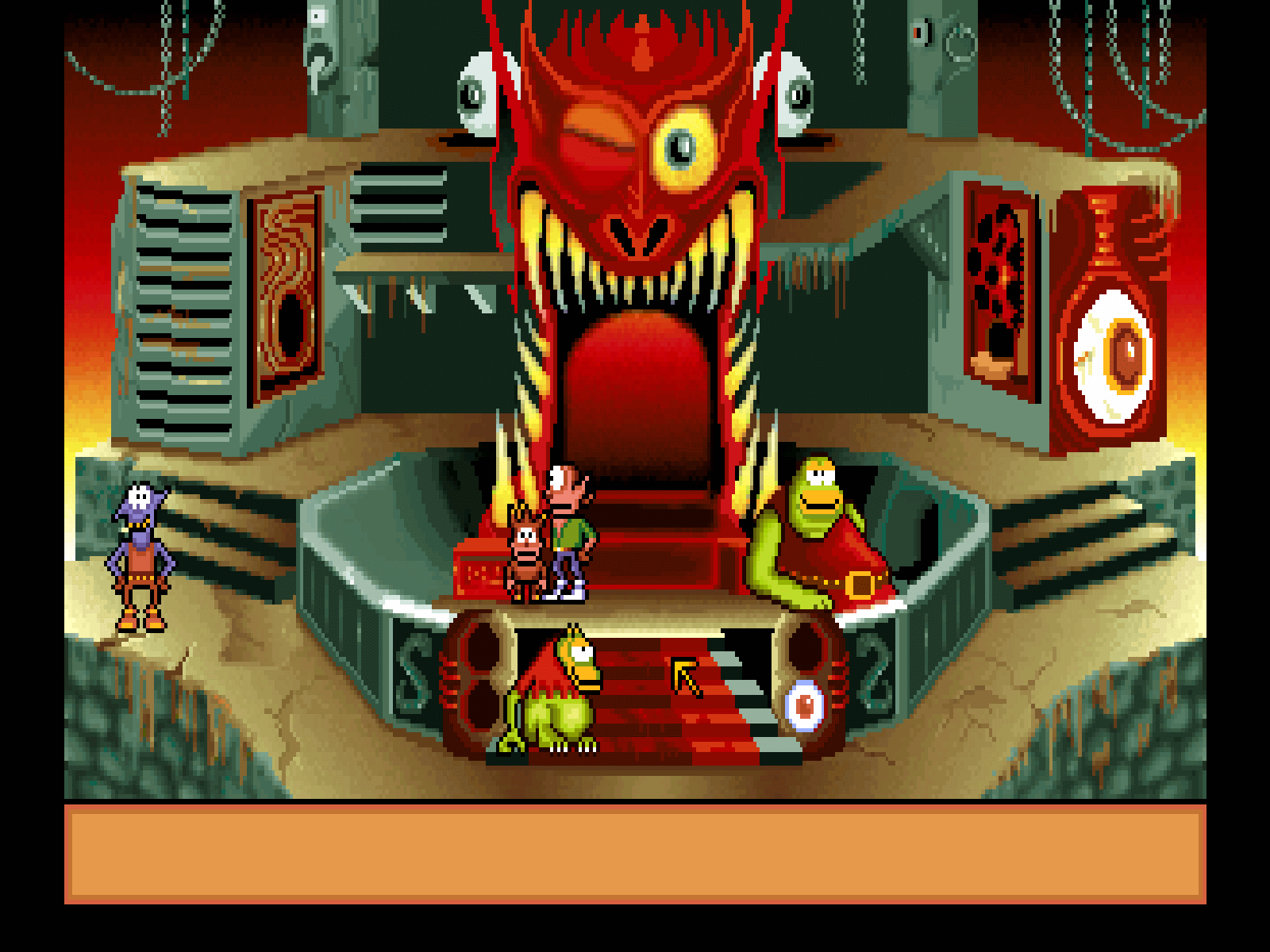
Movementwise, there was an interesting trick in the throne room. Usually the exits of a screen have been pretty much fixed. Not here. Whenever my goblins were at the right side of the screen, the exit list showed the kitchen. Then again, I could move the goblins through the various secret passageways to the left side of the screen (and no, moving in front of the eyes of the demons wasn't an option), where instead of kitchen the list of exits showed another room (we'll get back to that later).

On the throne room sat the evil demon Amoniak, and to the left of him was the Prince Buffoon I was here to rescue. But the demon lackey was interestingly called a lover of meatballs. Say, didn't I just see a big pile of those?

Indeed, in the kitchen, a servant was preparing them. He would put them through the window, one by one, suggesting he was feeding the demon lackey. I had been carrying a bottle of kindness elixir for a while now, and my suspicion was that I could spice the meatballs with it. In fact, when I tried to do it, goblins told me that the idea was good but they were afraid it would spill and the cook would throw the spiced meatballs away.

Checking the kitchen a bit more, I found out that pressing the eye of the swordfish would contort the fish, which would hit the goblin, who would fly to the salt shaker, which would drop to a position where it could be taken (remarkable cause-effect chains). Now, I could spice the meatballs with salt, and the cook would be reprimanded for oversalting.


Like this

For the couple of seconds cook wasn't sitting, I could interact with the case he was sitting on. What could I do with it? Well, I began by adding some salt in the big pot. Someone was apparently using it as a bath and was glad that we had put some bath salt in it. As a token of gratitude, I received a file, which could be used for releasing bird.


Although not from its cage

With the cage gone, I could move forward on the shelf and take some thumb tacks. Obviously, these were the things I could put on the case, while cook was being disciplined. When the cook sat on them, he lost the grip on the meatball he had been holding.


Poor cook should have stayed in bed today

This was a most frustrating sequence. Clearly I had to use the elixir with the meatball while it was flying. Problem was that time was so short and the spot I had to click was so small. Worst of it was that I had to do the whole salt-the-meatballs-wait-quickly-apply-the-thumb-tacks routine again, every time I failed in spicing the meatball. After dozens of failed attempts (and agony experienced by the cook), I finally managed to pull it off. Next time I entered the throne room, Amoniak's lackey was having a silly grin on his face


One down, two to go

My next target was Amoniak's demon dog that was said to eat cockroaches. This wasn't as intuitive a problem to solve as the one with the meatballs, but involved more of random experimentation. I noticed that if Fingus entered the ear of the demon throne and Winkle at the same time pulled at the tongue of a statue on the left, the left eye of the demon throne would open and Fingus would automatically manipulate the right eye, releasing a cockroach, which would walk toward the dog and be eaten after few seconds (yep, a bit random). The trick was to quickly take the cockroach through one of those magic holes and then to use some elixir on it.


The room at the other side of the throne room

Only one to go! Demon king Amoniak was dealt with a very similar manner as his underlings, that is, by mixing some kindness elixir into his food. I found a painter who told me that Amoniak ate only ladybugs. Since I knew where to get cockroaches, I tried painting one of them with red paint from the painter and adding some black spots from a pepper pot. It apparently was enough to fool Amoniak.


And then we were three

The game wasn't over yet. I still had to escape the castle, but I had no idea how to do it. After a while, I met the real king of the castle, locked inside his armour, hanging from a rope.


He's smaller than I expected

Amoniak had turned the king to a small child, and only his crown could turn him back to normal. I had already stolen from Amoniak this crown (one of the goblins could snatch it, while entering the head of the demon throne), which I now gave to the king. The castle scientist noticed this and went to find some help to release the king. With the scientist left, I could tinker with one of his machines.


Honey, I shrank the gobliins!

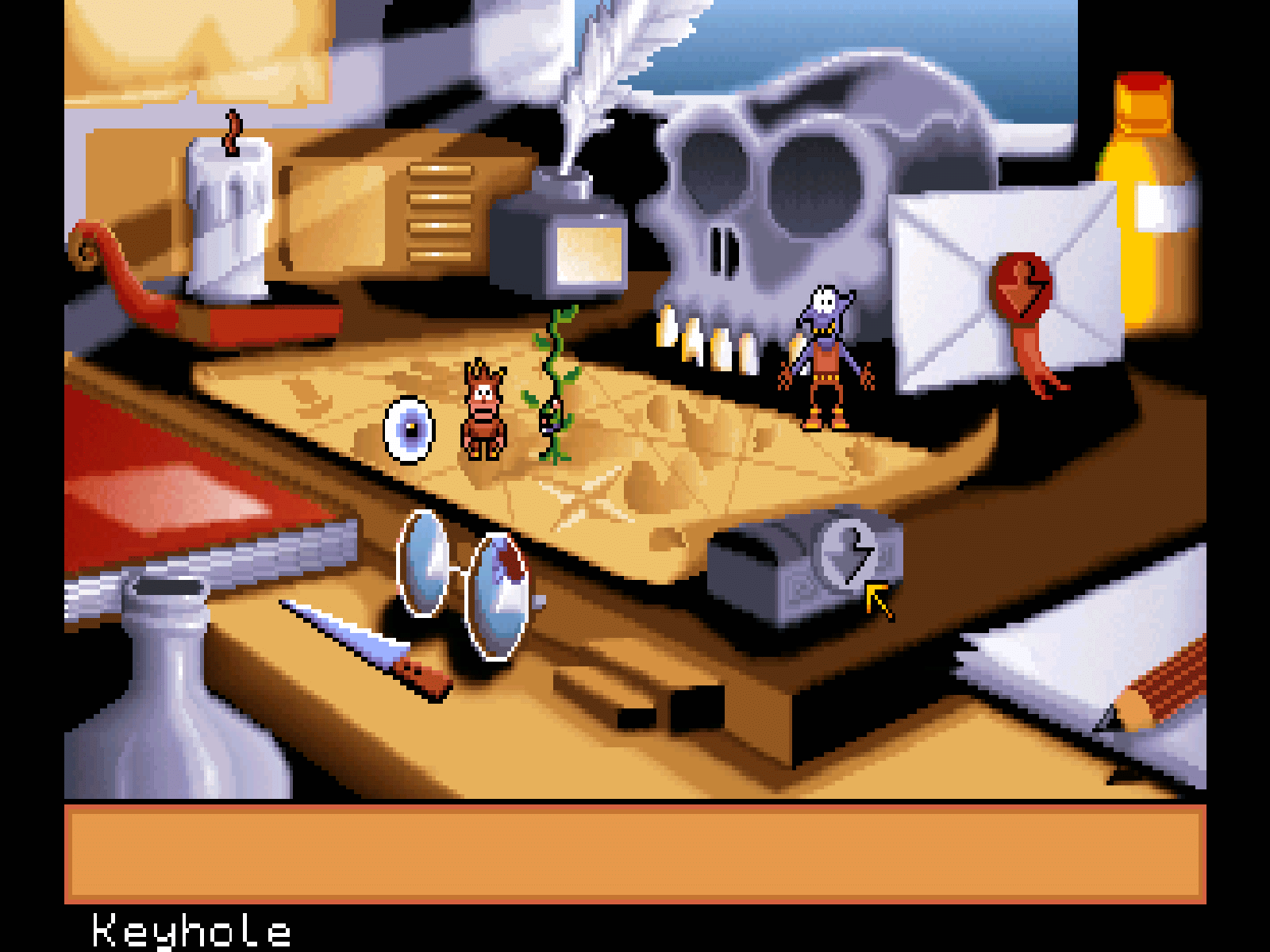
Finding myself on a desk (what desk actually is this?), I immediately noticed a box with a lock of a shape similar to one one on a seal. Should I use the seal to make an impression from the wax of the nearby candle and use it to open the box? If so, how could I get the wax?

Checking the other items, I noticed a pen knife that one goblin could lift for a couple of minutes. Using the other goblin on the knife during those few minutes moved the knife a few millimetres nearer to a book. Doing that couple of times brought the knife close enough to the book that I could cut from it a piece of the bookmark, which I could use as a wick of the candle.

What next? I picked up a match and used it to pry one glass eye from decorative skull. I tested what each goblin would do with the ball. They all kicked it, but Prince Buffoon particularly managed to break a piece from glasses with it. There was a conspicuous beam of sunlight coming from a window and hitting the candle. Using the piece of glass with that beam, the wick started to burn and a piece of wax dropped from the candle.

Just like I thought, I could shape the wax with the seal and the use this impression to open the box. Inside, I found some beans. Playing around with them for a while, I finally tried to use them on the map. To my surprise, the seed started to sprout a beanstalk - in the map. Without further ado, I entered the map.


I am getting confused. Was it a magic map? Did it teleport
me somewhere? If so, did I just create a huge beanstalk here?

It was definitely a silly ending, but just right what to expect from this game. And it wasn't the end, but only an end - the game still continues. What more lies ahead of me, now that I rescued the prince? We'll find that out next week.

But before ending completely, let me advertise a new feature of our blog. Our readers occasionally note that some noteworthy game is missing from our official list. We have been playing such missing games as Missed Classics, but there has been no way for our readers to suggest what to play as a Missed Classic. We admins decided it should be time to change this. Just for this reason, we've set up a simple spreadsheet (you can find the link also on the left column), where you can add your suggestion. We are still not sure how we will add your suggestions to our Missed Classic schedules, but we are working on it.

Inventory: match, file

Session time: 2 h 45 min
Total time: 19 h 15 min